
Automated Tail Suspension Test
The automatic tail-suspension test allows a fast and reliable screening of the psychotropic properties (anti-depressants, sedatives) of drugs.
- Fully automatic and operator-independent
- Includes 4 types of randomization processes of the animal list
- Measurement of up to 6 animals in the same run
- Full control of the calibration
- High predictability for antidepressant effects in humans
- Based on innate behaviours and despair models
- Widely used in literature and deeply validated in phenotyping and pharmacology
- Simple to set up and use
- Replay possible with other parameters
- Short-lasting experiment (usually 6 minutes)
- Optional video recording to adjust the activity threshold
- NEW Wireless Communication!
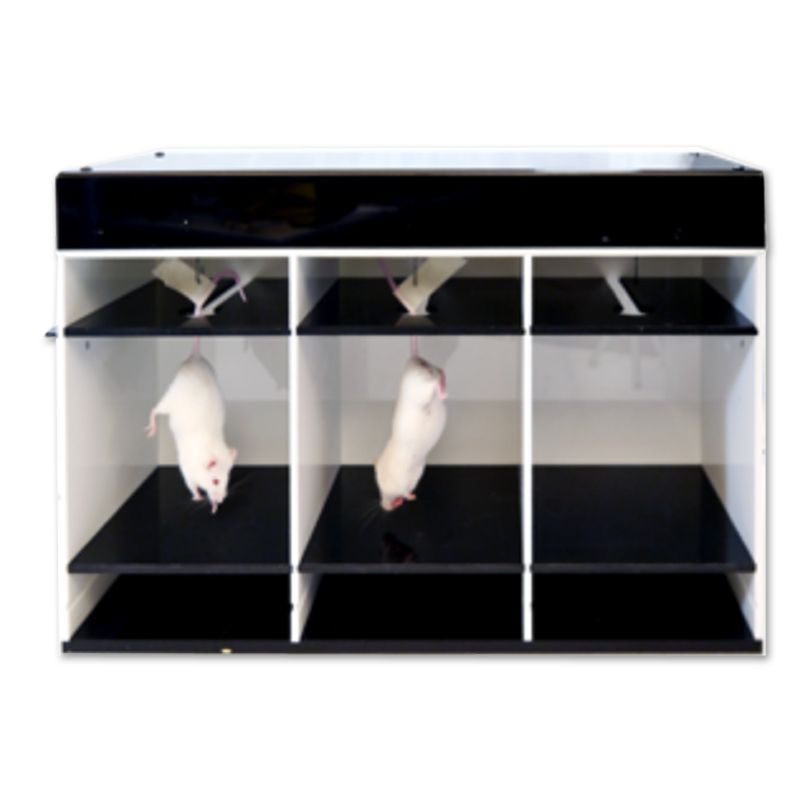
The automatic tail-suspension test allows a fast and reliable screening of the psychotropic properties (anti-depressants, sedatives) of drugs.
- Fully automatic and operator-independent
- Includes 4 types of randomization processes of the animal list
- Measurement of up to 6 animals in the same run
- Full control of the calibration
- High predictability for antidepressant effects in humans
- Based on innate behaviours and despair models
- Widely used in literature and deeply validated in phenotyping and pharmacology
- Simple to set up and use
- Replay possible with other parameters
- Short-lasting experiment (usually 6 minutes)
- Optional video recording to adjust the activity threshold
- NEW Wireless Communication!
Basically, the measuring principle is based on the energy developed by mice trying to escape from their suspension. During the test, the movements of the mice are analyzed in terms of force, energy and power developed over time.
The system includes the suspension cages (3 mice per cage) and a user-friendly software to run, record, analyze and replay the experiments. The results are either printed or stored in .txt or.xls files formats.
Citations
Alexandre C et al. (2006) Early Life Blockade of 5-Hydroxytryptamine 1A Receptors Normalizes Sleep and Depression-Like Behavior in Adult Knock-Out Mice Lacking the Serotonin Transporter. J. Neurosci. 26(20): 5554-5564. (mouse, France, Germany)
Cryan J et al. (2004) The tail suspension test as a model for assessing antidepressant activity: review of pharmacological and genetic studies in mice. Neurosci. Biobehav. Rev. 29(4-5):571-625. (mouse, Switzerland)
Mombereau C et al. (2004) Genetic and Pharmacological Evidence of a Role for GABAB Receptors in the Modulation of Anxiety- and Antidepressant-Like Behavior. Neuropsychopharmacol. 29:1050-1062 (mouse, Stwitzerland)
Strekalova T et al. (2004) Stress-Induced Anhedonia in Mice is Associated with Deficits in Forced Swimming and Exploration. Neuropsychopharmacol., 29(11):2007-17 (mouse, Germany).
| Specifications | 76-0780 |
|---|---|
| Number of animals | 1-3 mice if one set of cages is used, 1-6 mice if 2 sets of cages are used |
| Material Composition | Black and white PVC |
| Power | 110-230 Volts- 9 volts DC |
| Dimensions | 50 x 15 x 30 cm for a set of three cages |
| Acquisition sampling rate | 200 Hz for the sensors, 15 images/second for the camera |
| PC Requirements | OS: Windows 7 / 8, 32 64 bits, CPU: Intel Core i3, 2.4GHz or equivalent, RAM: 3Go, USB: USB 2 / USB 3, Display resolution: 1152x768 pixels, 1 free USB port / cage set + 1 free USB port for the camera, Compatible with touch-screen tablet using W8 |