Welcome to Harvard Apparatus! — Login / Register
Search

Search for these keywords
Home Catalogs Online Technical Resources
Shopping Cart Shopping
   Cart
                     My Account
Advanced Search   
Products by Category

Featured Products
Warner Cell Electrophysiology & Cell Biology Research
Hugo Sachs Elektronic Isolated Organ and Tissue Systems
BTX Electroporation and Electrofusion Products
Panlab Behavior Research Products
Hoefer Electrophoresis Products
Clark Glass Products
Navicyte Ussing/Diffusion Chambers
Harvard Apparatus

GoDaddy
 

Home Ventilators Volume Controlled MiniVent Ventilator for Mice, Single Animal Volume Controlled Ventilators


Larger Views


MiniVent Ventilator for Mice, Single Animal Volume Controlled Ventilators
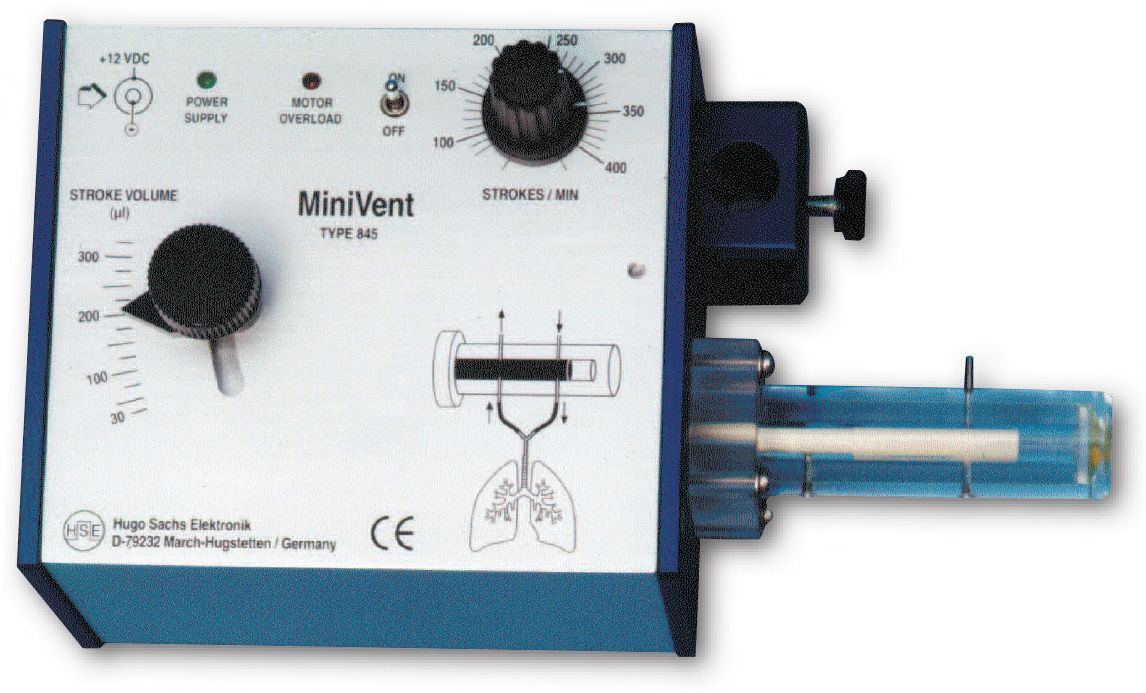
The HSE-HA MiniVent Mouse Ventilator is an ideal ventilator suited for mice. It is remarkable small in size and can be placed close to the animal. It provides a stroke volume from 30 to 350 µl and can ventilate from 60 to 400 breaths/minute. The stroke volume may be adjusted while the ventilator is running.
Search for Product in current catalog
Item Listing Full Description Specifications Journal Articles Manuals
Item# Description In Stock Lead Time U.S. List Price Quantity
730043 MiniVent Ventilator for Mice, 110 VAC -- 5 days View Pricing
Login to Shop
730044 MiniVent Ventilator for Mice, 230 VAC -- 5 days View Pricing
Login to Shop
734008 MiniVent & MicroVent End of Inspire Trigger, Must Be Purchased with Ventilator -- 10 days View Pricing
Login to Shop
734013 MiniVent & MicroVent End of Expire Trigger, Must Be Purchased with Ventilator -- 10 days View Pricing
Login to Shop
730027 MiniVent & MicroVent Package of 10 Small Y Adapters, each with 2x silicone tubing 1.5mm ID, 3mm OK, 14cm long -- 10 days View Pricing
Login to Shop
733736 Battery Pack for MiniVent & MicroVent Yes -- View Pricing
Login to Shop
733077 Ventilation Connection Kit for Model 687, MicroVent, MiniVent, and MidiVent Mouse Ventilator -- 10 days View Pricing
Login to Shop
732919 Minivent Mouse Ventilator Multi-Gas Inlet Adapter -- 10 days View Pricing
Login to Shop

For local pricing, contact your nearest distributor.


Full Description Back to Top

• Ideal ventilator for mice
• Stroke volume range from 30 to 350 µl
• Ventilation rate from 60 to 400 breaths/minute
• Simple adjustment of stroke volume while running
• Valveless piston pump, no valves to clog
• Very small instrument/circuit dead space volumne
• Compact construction, easy to install close to animal
• No vibrations, very low noise

The MiniVent Model 845 Ventilator is a quiet, compact and light weight ventilator. While it was designed specifically for mice, the MiniVent can be used for any animal (e.g. birds and perinatal rats) which requires tidal volumes in the range of 30 to 350 µl and respiratory rates of 60 to 400 breaths per minute.

The MiniVent Ventilator is a constant-volume respiration pump operating on the Starling principle. Unlike conventional units for larger animals, this ventilator employs a rotary plunger and has no valves. During each ventilation cycle, the plunger performs a synchronized forward and rotating movement. Cleverly arranged bores and channels in the cylinder and plunger control inspiration and expiration during each stroke of the plunger.

The extremely light weight and compact construction, in addition to the convenient rod clamp, allow the MiniVent ventilator to be positioned directly next to the animal. Typical setups with larger ventilators produce large tubing and instrument dead space volumes. These larger volumes introduce greater system compliance which can affect the accuracy with which the full tidal volume is introduced into the animal's lungs. With the MiniVent, the tidal volume error due to system compliance is reduced to ±3 µl.

Tidal volume and respiration rate can be set exactly to the values required for mouse ventilation. The level of precision and control available to the investigator minimizes the danger of hyperventilation or hypoventilation.

The tidal volume can be varied continuously from 30 to 350 µl during operation without having to interrupt ventilation. The respiration rate is also continuously adjustable from 60 to 400 strokes/min. The expired air can be recovered at the collection port for sampling, recycling or for the generation of a positive end-expiratory pressure (PEEP). Room air or any non-explosive gas mixture can be used to feed the pump intake.

The MiniVent is supplied with 1 x AC Wall Mounted Power Supply (115 V or 220 V); 2 x Silicone Tubing (1.5mm ID, 3.0mm OD, 14cm long); 1 x 1.3mm OD Tracheotomy Cannula (73-2730); 1 x 1.2mm OD Intubation Cannula (73-2844).

A multi-gas inlet adapter is available for the MiniVent so that alternate gas mixtures and nebulized substances are delivered to the MiniVent inlet port at atmospheric pressure. The adapter provides ports for multiple selectable gas mixtures (hypoxic, anesthetic...) and a port for the Aerosol Nebulizer.


Specifications Back to Top

Specifications730043730044734008734013730027733736733077732919
AC Adapter Weight English0.7 lb0.7 lb      
AC Adapter Weight Metric0.3 kg0.3 kg      
CertificationsCECE      
Control ModesVolumeVolume      
Depth English7.9 in7.9 in      
Depth Metric20 cm20 cm      
Displaynonenone      
Gas SupplyRoom air or non-flammable mixed gasRoom air or non-flammable mixed gas      
Height English3.1 in3.1 in      
Height Metric8 cm8 cm      
I E Ratio1:11:1      
I E Ratio UOM%%      
ModelMiniVentMiniVentMicroVent/MiniVentMicroVent/MiniVentMicroVent/MiniVentMicroVent/MiniVentMiniVentMiniVent
Net Weight English2.2 lb2.2 lb      
Net Weight Metric1 kg1 kg      
Number of Animals11111111
PEEPProvided via attachment of water columnProvided via attachment of water column      
Respiration Rate Maximum400 breaths/min400 breaths/min      
Respiration Rate Minimum60 breaths/min60 breaths/min      
Respiratory Rate NoteContinuously adjustable from 60 to 400 breaths/minContinuously adjustable from 60 to 400 breaths/min      
Sigh Frequencynonenone      
Sigh PressureNot availableNot available      
SpeciesMice, Prenatal Rats, Small BirdsMice, Prenatal Rats, Small Birds  Perinatal Mice, Small BirdsPerinatal Mice, Small BirdsMiceMice
Stroke Volume NoteContinuously adjustable from 0.03 to 0.35 ml/strokeContinuously adjustable from 0.03 to 0.35 ml/stroke      
Tidal Volume Maximum0.35 ml/stroke0.35 ml/stroke      
Tidal Volume Minimum0.03 ml/stroke0.03 ml/stroke      
Voltage Range110 VAC230 VAC      
Weight Range Maximum50 g50 g      
Weight Range Minimum1 g1 g      
Width English3.9 in3.9 in      
Width Metric10 cm10 cm      

Back to Top


Journal Articles Back to Top

Displaying 1 to 10 of 33 results for MiniVent Ventilator for Mice, Single Animal Volume Controlled Ventilators   Page 1  2  3  4 

Score

Document

Description

100% Login to view VT12 Small rodent ventilator use in finding chronic measurement of cardiac output in conscious mice.pdf
[184 KB]
Small rodent ventilator use in finding chronic measurement of cardiac output in conscious mice
95% Login to view VT06 Ventilator use in finding load as an acute determinant of end-diastolic pressure-volume relation.pdf
[200 KB]
h4Ventilator use in finding load as an acute determinant of end-diastolic pressure-volume relation010100051p
90% Login to view VT26 Mini Ventilator use in finding Heterozygous deficiency of hypoxia-inducible factor 2a.pdf
[1.2 MB]
Mini Ventilator use in finding Heterozygous deficiency of hypoxia-inducible factor 2a
73% Login to view VT35 Animal Respirator use in finding Anesthetic inhibition in ischemic and nonischemic murine heart.pdf
[194 KB]
Animal Respirator use in finding Anesthetic inhibition in ischemic and nonischemic murine heart
65% Login to view HS20 Nitric Oxide prevents cardiovascular disease.pdf
[682 KB]
pq210011609p
63% Login to view VT24 Intramucosal-arterial Pco2 gap fails to reflect intestinal dysoxia in hypoxic hypoxia.pdf
[156 KB]
MiniVent use in finding Evidence for Synergy Between Adrenergic and Nonadrenergic Mechanisms in Central Blood Pressure Regulation
55% Login to view VT36 Ventilator use in finding Water Permeability of Capillaries in the SFO.pdf
[467 KB]
Ventilator use in finding Water Permeability of Capillaries in the SFO
52% Login to view VT23 Inhibition Shapes Frequency Response Areas with Small Animal Ventilator.pdf
[673 KB]
Inhibition Shapes Frequency Response Areas with Small Animal Ventilator
50% Login to view VT03 Rodent Ventilator use in finding Reduced PO2 and Adenosine Formation Preserve Arteriolar Nitric Oxide.pdf
[283 KB]
Rodent Ventilator use in finding Ventilatory and metabolic responses to hypoxia in the smallest simian primate, the pygmy marmoset
46% Login to view VT30 Rodent Ventilator use in Antisense Knockdown of the Gial Glutamate Transporter GLT-1.pdf
[366 KB]
Rodent Ventilator use in Antisense Knockdown of the Gial Glutamate Transporter GLT-1
   

Back to Top


Manuals Back to Top

Displaying 1 to 2 of 2 results for MiniVent Ventilator for Mice, Single Animal Volume Controlled Ventilators  

Score

Document

Description

100% Login to view Model613 550715.pdf
[270 KB]
Large Animal Volume Controlled Ventilator Manual
58% Login to view 550000 Ventilator 683 Manual.pdf
[363 KB]
Model 683 Small Animal Ventilator User's Manual
   

Back to Top


  Privacy Policy   |   Terms and Conditions   |   Site Map
Copyright©2004 Harvard Apparatus - All rights reserved.
1-800-272-2775   1-508-893-8999
Website-related comments or concerns can be emailed to our webmaster.

Anesthesia Equipment Animal Handling Products Behavior Research Products Biological Measurement Products Cardiovascular Products Cell Biology Products CPK® Atomic Models Delivery & Sampling Products Dialysis / Sample Prep / SPE Electrophysiology Products Electroporation / Transfection General Laboratory Products Homeothermic/Temperature Control Isolated Organ & Isolated Tissue Microincubation / Microinjectors Molecular Biology Products Neuroscience Products Non-Invasive Blood Pressure Physiology Products Respiratory Products Stereotaxic Instruments Surgical Equipment Surgical Instruments Syringe Pumps/Peristaltic Pumps Tubing & Connectors Ventilators Application Specific Product Overviews