
Spatial Place Preference Box (Panlab)
Price on Request
The spatial place preference box is an experimental chamber developed with the aim to optimize place preference and aversion studies in small laboratory animals, especially mice.
- Allows a multiple combination between the visual, tactile and spatial cues defining each compartment
- Optimize the differentiation between compartments
- Minimize initial place preference during pre-test phase
- Transparent walls to minimize time spent in the corridor
- Optimize subject detection using a video-tracking system
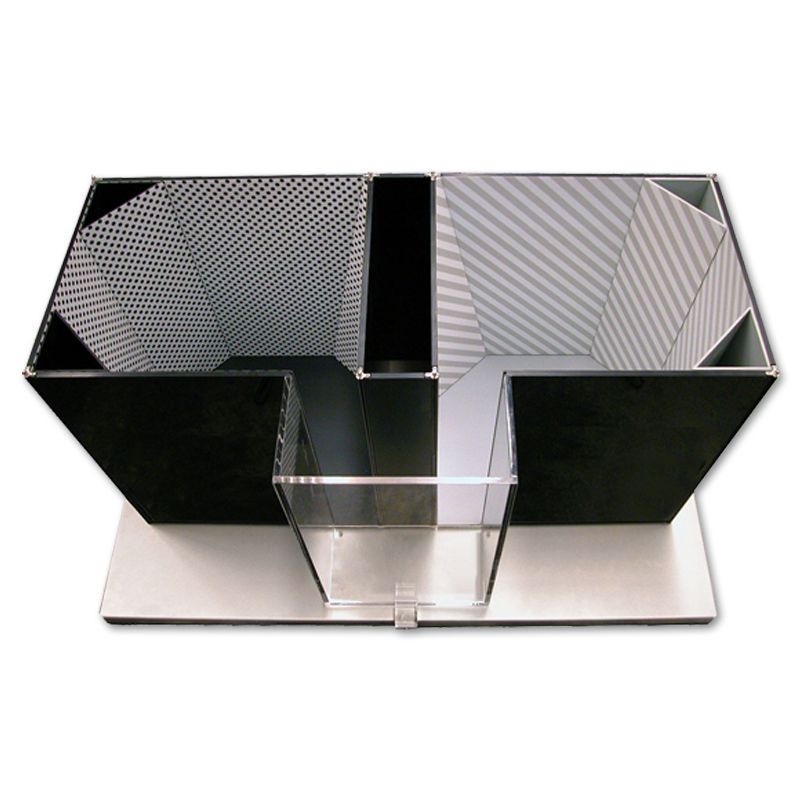
The Spatial place preference box is an experimental chamber developed with the aim to optimise place preference and aversion studies in small laboratory animals, especially mice. The design of the box is fruit of a close collaboration with eminent Professor Dr. Rafael Maldonado and Dr. Olga Valverde from the Laboratory of Neuropharmacology in Barcelona (Spain).
The apparatus consists in a box with two equally sized compartments interconnected by a rectangular corridor. Originally, the compartments are differentiated by the motifs painted on the walls (dots or stripes) and the colour (different shade of grey tones, light or dark) and texture (smooth or rough) of the floor. The innovation brought by the Panlab box is the possibility to combine a new additional spatial dimension to allow the animal differentiate the different compartments in a more discriminative manner. Transparent walls are also used to minimize the time the animal spent in the corridor.
The introduction of these new discriminative elements allows:
For the automated models (76-0441/LE898 and 76-0278/LE895), the detection of the position of the animal is provided by the weight transducer technology and PPCWIN software.
The apparatus consists in a box with two equally sized compartments interconnected by a rectangular corridor. Originally, the compartments are differentiated by the motifs painted on the walls (dots or stripes) and the colour (different shade of grey tones, light or dark) and texture (smooth or rough) of the floor. The innovation brought by the Panlab box is the possibility to combine a new additional spatial dimension to allow the animal differentiate the different compartments in a more discriminative manner. Transparent walls are also used to minimize the time the animal spent in the corridor.
The introduction of these new discriminative elements allows:
- Optimising the results obtained in the place preference and aversion paradigms (low variability in the response, reduced number of animals per group...)
- Organizing the discriminative elements in a wide variety of configurations for studies evaluating spatial or contextual memory
- Using the elements as discriminative cues associated with drug exposure in diverse other experimental designs.
For the automated models (76-0441/LE898 and 76-0278/LE895), the detection of the position of the animal is provided by the weight transducer technology and PPCWIN software.
| Specifications | 76-0279 | 76-0278 |
|---|---|---|
| Catalog Pages | G59 | G59 |
| Corridor Depth | 13 cm | 7 cm |
| Corridor Height | 45 cm | 25 cm |
| Corridor Width | 25 cm | 20 cm |
| Model Number | LE897 | LE895 |
| Mouse Cage Depth External | 27 cm | |
| Mouse Cage Depth Internal | 18 cm | |
| Mouse Cage Height External | 25 cm | |
| Mouse Cage Height Internal | 25 cm | |
| Mouse Cage Width Internal | 45 cm | 20 cm |
| Mouse Cage Widtht External | 46 cm | |
| Rat Cage Depth External | 88 cm | |
| Rat Cage Depth Internal | 40 cm | |
| Rat Cage Height External | 47 cm | |
| Rat Cage Height Internal | 34 cm | |
| Rat Cage Width External | 45 cm | |
| Related Software | PPCWIN | PPCWIN |
| Texture | One side of floor is textured, other side is smooth | One side of floor is textured, other side is smooth |
| Walls Width | 6 mm | 6 mm |